

Summary Judgment in Blake Lively v. Justin Baldoni: Part 1 - Understanding the Standard
The Summary Judgment Series: Will Blake Lively's Case Against Justin Baldoni End Before Trial? Understanding Summary Judgment

The views expressed in this post are my own opinions based on publicly available court filings and documents as of January 2026. I am not involved in this case and have no access to non-public information, sealed filings, or privileged communications. This analysis could change as new documents are released or additional information becomes available.
If you’ve been following the Blake Lively v. Justin Baldoni case, you know it’s been a procedural rollercoaster, sanctions motions, spoliation arguments, discovery fights, and now we’ve hit a major case milestone: summary judgment.
Summary judgment in this case is complicated. There are multiple claims, extensive factual disputes, and thousands of pages of evidence. Trying to cover it all in one post would be overwhelming (and honestly, unreadable).
So I’m breaking this down into a series:
ABOUT THIS SERIES
Part 1 (this post): Understanding the legal standard. What summary judgment is, how it works, and what Judge Liman will be looking at.
Part 2: What Judge Liman’s typical summary judgment decisions look like (and how long they typically take).
Part 3: The facts. What happened, what’s disputed, and what both sides agree on.
Part 4 and beyond: Claim-by-claim analysis, looking at each specific legal claim (sexual harassment, retaliation, defamation, etc.) and what both side are arguing.
By the end of this series, hopefully you’ll understand not just what Judge Liman (might) decide, but why, and you’ll be able to follow along with the legal reasoning.
For now, let’s start with the basics.
WHAT IS SUMMARY JUDGMENT?
Summary judgment is when one party asks the court to decide the case (or parts of it) before it goes to a jury trial.
The basic argument?
“Your Honor, there’s no genuine factual dispute here. If you apply the law to the undisputed facts, we win. No trial needed.”
Under Federal Rule of Civil Procedure 56, either party can file a motion for summary judgment arguing that the facts aren’t really in dispute, and when you apply the law to those facts, they should win as a matter of law.
Think of it as the “prove it or get it out of here” stage of litigation.
If the judge agrees there’s no genuine dispute of material fact, the case (or certain claims) ends right there. No witnesses. No jury. No dramatic courtroom scene. Just a legal ruling based on the record.
THE LEGAL STANDARD: WHAT DOES “NO GENUINE DISPUTE” MEAN?
This is the key question: Is there a genuine dispute of material fact?
Let’s break that down:
“Genuine dispute” = Could reasonable people look at the evidence and disagree about what actually happened?
If yes → genuine dispute → case goes to trial
If no → no genuine dispute → judge can decide it now
“Material fact” = Does this dispute actually matter to who wins under the law?
Some facts are disputed but don’t matter legally. Those don’t save you from summary judgment.
Example:
“Did Baldoni hire crisis PR in May or June?” = Might be disputed, but probably not material
“Did Baldoni hire crisis PR to retaliate against Blake for reporting harassment?” = Definitely material
THE BIG RULE: VIEW EVIDENCE IN THE LIGHT MOST FAVORABLE TO THE NON-MOVING PARTY
This is huge.
When deciding summary judgment, the judge has to view all the evidence, and all reasonable inferences from that evidence, in the light most favorable to the party opposing the motion.
What this means in practice?
If Lively moves for summary judgment, Judge Liman has to view the evidence in the light most favorable to Baldoni.
If Baldoni moves for summary judgment, Judge Liman has to view the evidence in the light most favorable to Lively.
That’s why summary judgment is less about drama and more about detail. You need the evidence to be so clear that no reasonable jury could rule against you.
WHAT DOES A SUMMARY JUDGMENT MOTION ACTUALLY LOOK LIKE?
It’s not one quick filing. It’s a massive coordinated package of documents. Here’s what gets filed:
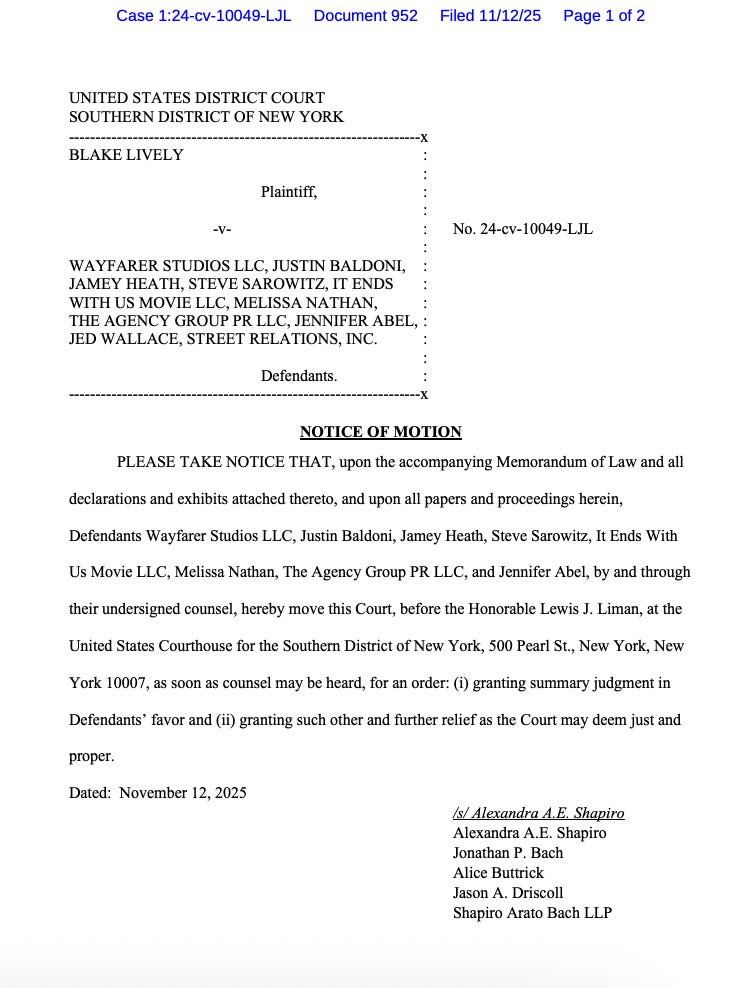
1. The Notice of Motion
A formal request asking the court to grant summary judgment on specific claims. That is the image at the top of this post.
2. Memorandum of Law
This is the legal argument. It lays out:
Table of Authorities (the law you are citing through the motion)
Introduction
Statement of Facts
Argument that lays out:
What the legal standard is
What elements each claim requires
Why the evidence (or lack thereof) means the moving party should win
Why there’s no genuine dispute of material fact
Conclusion
This is typically 25+ pages of dense legal argument with extensive citations to case law.
3. Rule 56.1 Statement of Undisputed Material Facts
This is the heart of the motion.
It’s a numbered list of every fact the moving party claims is undisputed. Each fact must be tied to specific admissible evidence.
Example from Balondi’s Rule 56.1 Statement:
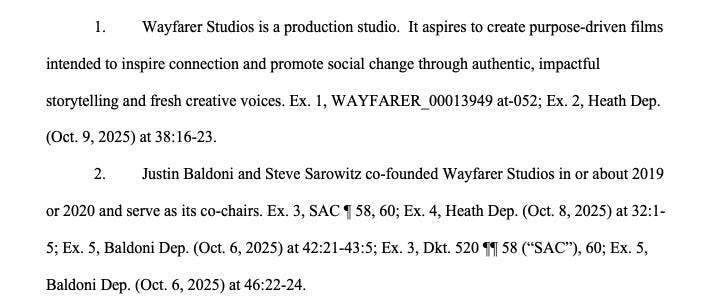
Every. Single. Fact. Must be supported by citation to the record.
If you claim something is undisputed but don’t cite evidence, it doesn’t count.
4. Supporting Declarations and Exhibits
All the actual proof:
Deposition transcripts
Emails
Text messages
Contracts
Expert reports
Documents produced in discovery
Everything cited in the 56.1 Statement has to be attached as an exhibit. There are 100s of exhibits here.
JUDGE LIMAN’S SPECIFIC REQUIREMENTS
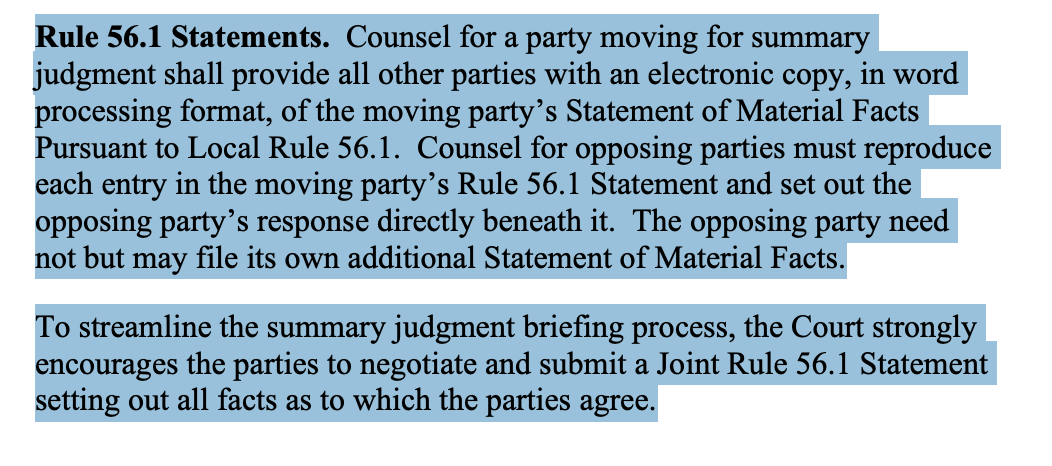
As shown in the above image, Judge Liman has Individual Practices that parties must follow. For summary judgment, he requires:
1. Word Version of 56.1 Statement
The moving party must provide the opposing party with a Word document version of their Rule 56.1 Statement (every numbered “undisputed” fact).
2. Line-by-Line Response
The opposing party then copies each numbered paragraph and responds directly underneath it.
Example from Blake Lively’s Rule 56.1 Response:
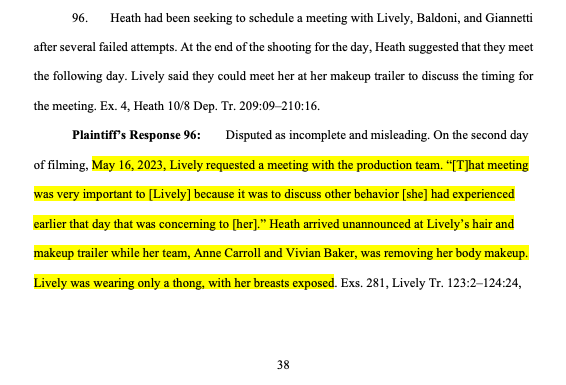
Every Response Must Be Tied to Admissible Evidence
You can’t just say “disputed.” You have to cite to specific evidence in the record that creates a genuine dispute.
HOW THE BURDEN OF PROOF WORKS
Step 1: Moving Party’s Burden
The party filing for summary judgment has to show one of two things:
Option A: Present evidence that disproves a key element of the other side’s claim
Example: “Blake claims retaliation, but here’s proof Baldoni hired crisis PR before she ever complained about workplace issues, so it couldn’t have been retaliatory.”
Option B: Argue that the other side has no admissible evidence to support an essential element.
Example from the 56.1 Statements:
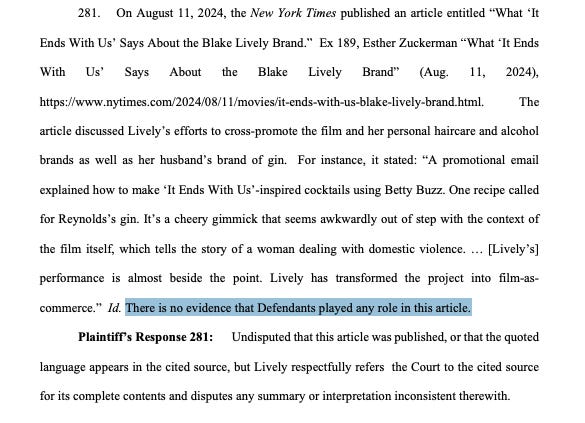
Step 2: Non-Moving Party’s Burden
Once the moving party makes their showing, the burden shifts.
The opposing party must show the record does contain real, admissible evidence that creates a factual dispute.
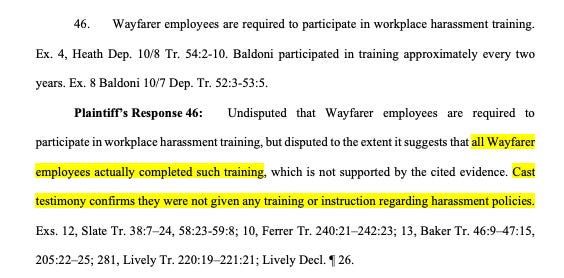
You can’t just say “that’s wrong.”
You have to point to specific evidence (depositions, documents, expert reports) that shows reasonable people could disagree.”
THE TWO KEY QUESTIONS JUDGE LIMAN WILL ASK
Question 1: Is there a “genuine dispute”?
Could a reasonable jury look at this evidence and see it differently?
If conflicting testimony exists → genuine dispute → survives
If credibility is at issue → genuine dispute → survives
If evidence could support multiple interpretations → genuine dispute → survives
Question 2: Is the dispute about a “material” fact?
Does this disagreement actually matter to who wins under the law?
If it goes to an essential element of a claim → material → survives
If it’s a side issue that doesn’t affect the legal outcome → not material → doesn’t save you
Both questions must be “no” for summary judgment to be granted.
If there’s a real factual fight, conflicting testimony, credibility issues, multiple interpretations, the claim survives and goes to trial.
The judge is NOT the jury at summary judgment.
The judge doesn’t decide who’s telling the truth. That’s the jury’s job.
The judge only decides: “Is there a factual dispute here that a jury needs to resolve?”
ORAL ARGUMENT: WHAT TO EXPECT
Unlike many summary judgment motions that are decided “on the papers” (just based on the written submissions), Judge Liman held oral argument on January 22, 2026 on the summary-judgment motions (and related spoliation issues). The hearing ran about three hours.
What is oral argument?
It’s when the lawyers for both sides appear before the judge to answer questions and argue their positions in person.
What happens at oral argument:
Before the hearing:
Judge Liman will have read all the briefs, the Rule 56.1 Statements, and reviewed the key evidence
He’ll have identified the issues he wants to hear more about
He may have tentative views on certain points
During the hearing:
Each side gets a set amount of time to present their arguments (here one hour)
The judge will interrupt with questions (a lot of questions)
This isn’t a speech, it’s more a conversation where the judge tests the strength of your arguments and asks about specific things
Lawyers have to be ready to pivot based on what the judge is focused on
Given the complexity of the claims, the volume of evidence, and the contentious nature of the litigation, Judge Liman had a lot of questions.
WHAT HAPPENS AFTER SUMMARY JUDGMENT?
If Judge Liman DENIES summary judgment:
The case (or the surviving claims) goes/go to trial. A jury will decide the disputed facts.
If Judge Liman GRANTS summary judgment:
Those issues are decided right there. No jury needed. The case (or those claims) is over.
Partial summary judgment is common:
The judge might grant summary judgment on some claims but deny it on others.
Even if summary judgment is granted, it can be appealed. But that’s for later.
WHY THIS IS A BIG DEAL
Summary judgment is one of the most defining moments in any case.
It’s the point where you stop arguing what happened and start arguing what it means under the law.
It’s not just another filing. It’s an all-hands-on-deck, months-of-evidence, late-nights-and-Red-Bull kind of moment.
For the moving party: This is your chance to end the case (or parts of it) without the risk of a jury trial.
For the opposing party: This is your chance to show the evidence is strong enough that a jury needs to hear it.
For both sides: It’s a forced reckoning with your evidence.
WHAT THIS MEANS FOR LIVELY V. BALDONI
This case is... complicated.
We’re talking about:
Multiple claims (retaliation, workplace harassment, defamation)
Extensive discovery disputes
Pending spoliation motions
Sanctions motions
Repeated discovery violations
A docket that looks like a procedural war zone
Given all that, claiming “no genuine dispute exists” is... bold.
When your discovery record looks like a minefield, Rule 56 isn’t exactly easy.
WHAT’S NEXT
In the next parts of this series, we’ll start to get into:
Judge Liman’s style/timing/and what his Summary Judgment decisions have looked like in the past
The specific claims Baldoni and Co. moved for summary judgment on
What their key arguments are
What evidence they’re citing
What we can expect Judge Liman to focus on
For now, just remember…
Summary judgment is when the court decides: “Is there enough here for a jury to decide, or can I decide it now based on the law?”
It’s evidence-intensive, procedure-heavy, and absolutely critical.
And in a case like this one, with this much bad blood, this many discovery fights, and this much at stake, it’s going to be fascinating to see how Judge Liman navigates it.
Stay tuned for Part 2, where we’ll get into the actual claims and arguments.
If you have questions about summary judgment procedure, drop them in the comments.
P.S. for my favorite fans, yes I got an A+ in Federal Civil Procedure too.
© More with MJ 2025. All rights reserved.
I see that you said that every statement that the moving party makes in their Rule 56.1 has to be cited. I noticed a lot of times in Lively’s response where she says something like “undisputed except for xyz which the cited evidence does not support”. For example #5 in which Baldoni references Jane the Virgin receiving awards. So basically, Baldoni didn’t actually include evidence of that in the exhibits which is why Lively is disputing it here, right?
I love this!! So happy to read all your posts! Got substack just for you!