

Filed & Famous: The Second Circuit Might Have Killed One of Justin Baldoni’s Attempts to Avoid a Trial With Blake Lively
A one-page letter. A three-day-old decision. And one of Justin Baldoni's attempts to avoid trial may be... dead.

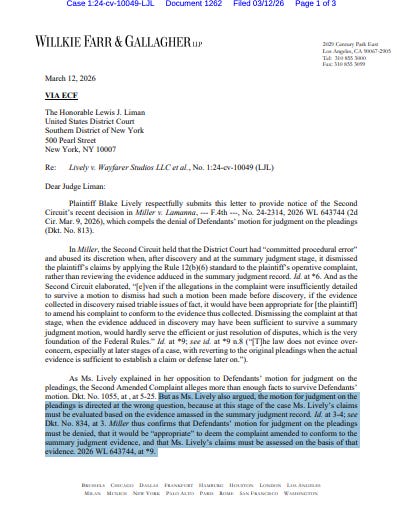
Today Blake Lively’s lawyers filed a one-page letter with Judge Liman. It cites one case (a Second Circuit decision from three days ago) and it may have just killed one of Justin Baldoni’s attempts to avoid a trial with Blake Lively.
One quick point before we dive in. In the federal court system, trial judges have to follow the rulings of the appeals court above them. In New York, that appeals court is the Second Circuit. When the Second Circuit announces a legal rule, federal judges in New York are required to apply it.
With that, let’s get into it.
First: What Motion is He Talking About?
In this lawsuit, Baldoni’s team filed two motions trying to end the case before trial.
Before we get into this letter, you need to understand the difference between the two.
Motion #1: Judgment on the Pleadings (Rule 12(c) - the “MJOP”). This is the sneaky one. A motion for judgment on the pleadings is filed under Rule 12(c) of the Federal Rules of Civil Procedure. Instead of looking at the evidence, the court only looks at Lively’s original complaint, the piece of paper her lawyers filed at the beginning of the case.
No texts. No depositions. No “we can bury anyone.” No “social combat plan.” Just the pleadings.
The question is: did the complaint say enough words in the right order to state a valid legal claim? The legal standard is the same as a motion to dismiss under Rule 12(b)(6), the only difference is timing.
A 12(b)(6) motion is filed before the answer; a 12(c) motion is filed after an answer. Same standard, later in the case.
It is unusual to see a Rule 12(c) motion pressed after discovery and right before a summary judgment motion, which is what Justin Baldoni’s team did here.
Motion #2: Summary Judgment (Rule 56). This is the big one. The court looks at all the evidence (every text message, every deposition, every document produced in discovery that the two sides put before the court) and asks: is there enough here for a jury to decide? Both sides filed massive briefs and statements of facts on this. This motion is still pending.
See why a defendant might prefer Motion #1? If the evidence that came out in discovery sucks for you (and in this case, it kind of does) you’d much rather have the judge reading the complaint than reading your text messages or the deposition transcripts from witnesses.
Baldoni’s team filed their MJOP late (end of September). Discovery was already done (or should have been but for some of their issues). The summary judgment record was already compiled. And they asked the court to ignore all of it and go back to evaluating the complaint.
Lively’s lawyers said: that’s the wrong question at this stage of the case.
The defendants replied: too bad, the complaint is deficient on its face.
All of this was briefly touched upon in front of Judge Liman on January 22, 2026 (when the lawyers argued the summary judgment motion). He hasn’t ruled yet.
Wait a second… can Lawyers Just File Letters Like This?
Yes. This is completely normal and, frankly, expected.
When a new court decision comes out that is directly relevant to a pending motion, lawyers have an obligation to bring it to the court’s attention. It’s called a “notice of supplemental authority.”
Judges are busy. They have hundreds of cases. When a binding appellate decision comes down that speaks directly to an issue the judge is actively considering, the responsible thing (and in some jurisdictions, the required thing) is to flag it immediately.
That’s what Gottlieb did. He didn’t file a new brief. He didn’t reargue the motion. He wrote a short letter saying: this new decision exists, here’s what it holds, and here’s why it controls the pending motion. Courts receive letters like this routinely. There is nothing unusual, aggressive, or improper about it. It’s… clever lawyering 😉.
Contrary to what you may see circulating online, nothing in the filing misrepresents the case.
A notice of supplemental authority alerts the court to a new appellate decision issued while motions are pending. Miller v. Lamanna addresses the procedural issue of reverting to the pleading standard after discovery and ignoring the evidentiary record. Whether that reasoning ultimately applies to the motion here is for Judge Liman to decide… which is exactly why lawyers notify the court when relevant precedent comes out.
Courts receive letters like this routinely. There is nothing unusual, aggressive, or improper about it.
What Just Happened
On March 9, 2026, three days ago, the Second Circuit (that’s the federal appeals court that controls all federal courts in New York, including SDNY /Judge Liman’s court) issued a ruling in a completely unrelated case called Miller v. Lamanna.
In Miller, a similar (but not identical) thing happened.
After two years of discovery, the defendants asked the court to throw out the case. Instead of evaluating the actual evidence, the trial court went back to the complaint and said: your complaint doesn’t say enough.
Case dismissed.
All that discovery? Ignored.
The plaintiff appealed. And the Second Circuit reversed.
What the Majority Actually Said
I’m going to walk through the majority opinion directly (you can read it here), because people on the internet are going to tell you this case doesn’t apply to the Lively MJOP.
That interpretation misses the broader reasoning of the opinion.
Here’s why.
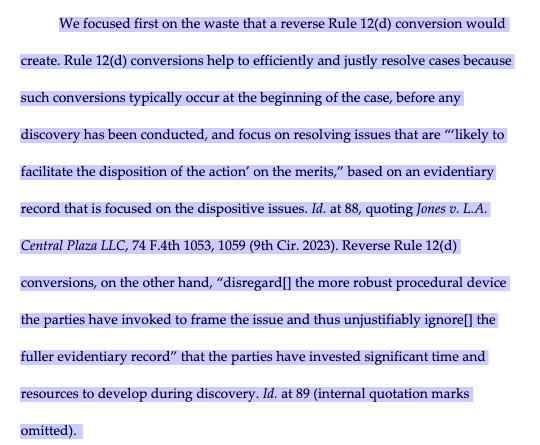
The majority held that reverting to the pleading standard after discovery can be procedural error. The court explained that this kind of move,which it calls a “reverse Rule 12(d) conversion” “disregard[s] the more robust procedural device the parties have invoked to frame the issue and thus unjustifiably ignore[s] the fuller evidentiary record” that the parties invested significant time and resources to develop. Miller, 2026 WL 643744, at *16:
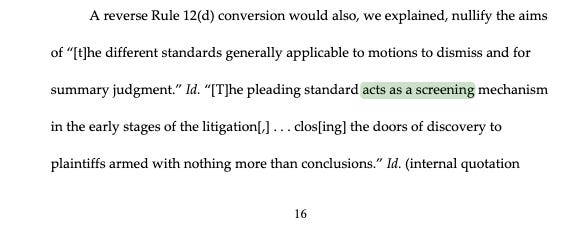
The majority wrote that the pleading standard is a screening tool for the early stages of a case not for post-discovery litigation. The court said the pleading standard “acts as a screening mechanism in the early stages of litigation,” requiring a complaint to “allege sufficient facts to raise a reasonable expectation that discovery will reveal evidence of the defendant’s wrongdoing.”
But, and this is the key, “once the parties have already incurred the expense of discovery, that objective becomes inapposite.” Id. at *16-17.
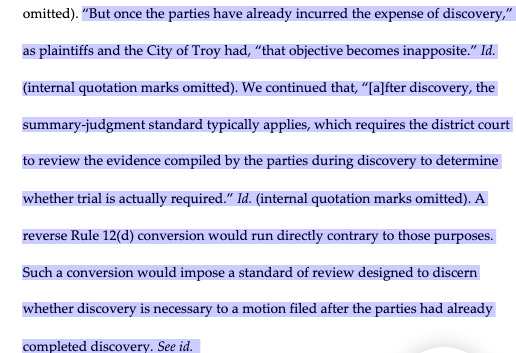
Let me translate “inapposite” for you: it means it doesn’t apply anymore.
The whole point of the pleading standard is to decide whether discovery should happen.
Once discovery already happened, asking whether the complaint justified discovery is a meaningless question.
The majority suggested that where discovery evidence fills gaps in the complaint, dismissing based solely on pleading deficiencies becomes difficult to justify.
The court explained that if the summary judgment record shows the plaintiff has raised sufficient evidence, “dismissing the case based on pleading deficiencies in the complaint’s factual allegations seems difficult to justify because the fruits of discovery would have revealed that the pleading deficiency is curable.” Id. at *17-18.
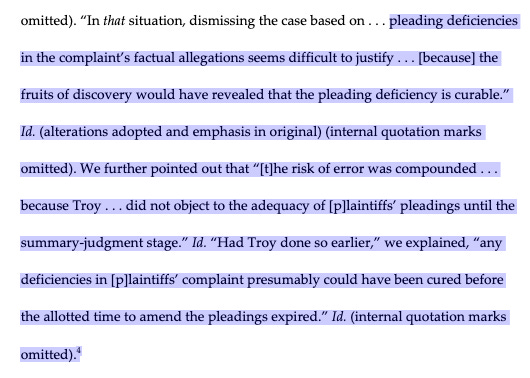
The court also pointed out that filing a pleading challenge this late in the case compounds the risk of error, if defendants had challenged the complaint earlier, any deficiencies “presumably could have been cured before the allotted time to amend the pleadings expired.” Id. at *18.
The majority explicitly stated that its reasoning is not limited to standing cases. This matters because some people will try to tell you that the earlier case this builds on (Lugo v. City of Troy) only applies to Article III standing challenges, not to the sufficiency of pleadings generally. The majority directly addresses and rejects that argument. The court said: “Nothing in Lugo suggests that our reasoning was specific to cases in which the issue on which summary judgment or dismissal was sought involved standing.” Id. at *22. The court went further: the reasoning in Lugo “relied on the standard for granting summary judgment on any ‘claim or defense, including on standing’”. Id.
And then the majority dropped this passage in a footnote, which is worth reading carefully:
“the question here is not about what burden the plaintiff bears to avoid summary judgment — plaintiff agrees that he must now do more than allege facts that render his claim plausible, by adducing evidence sufficient to raise genuine issues of fact, and contends that he can and does carry that burden — but rather about whether the defendant can ignore the evidence to which plaintiff points and win the case by reverting to the pleading stage, obtaining a dismissal because the complaint was, as a matter of pleading, insufficient.“ Id. at *22-23.


Read that again.
The Second Circuit is describing (in pretty exact terms) what Baldoni’s team tried to do with their MJOP.
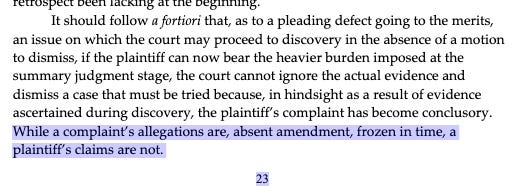
The majority held that this applies a fortiori to challenges on the merits, not just standing. The court reasoned that if Lugo required evidence-based analysis even for standing (which is a jurisdictional, constitutional requirement), then “it should follow a fortiori that, as to a pleading defect going to the merits . . . if the plaintiff can now bear the heavier burden imposed at the summary judgment stage, the court cannot ignore the actual evidence and dismiss a case that must be tried because, in hindsight as a result of evidence ascertained during discovery, the plaintiff’s complaint has become conclusory.” Id. at *23.
And then this line: “While a complaint’s allegations are, absent amendment, frozen in time, a plaintiff’s claims are not.“ Id
Lastly, the majority also addressed a point that is directly relevant here.
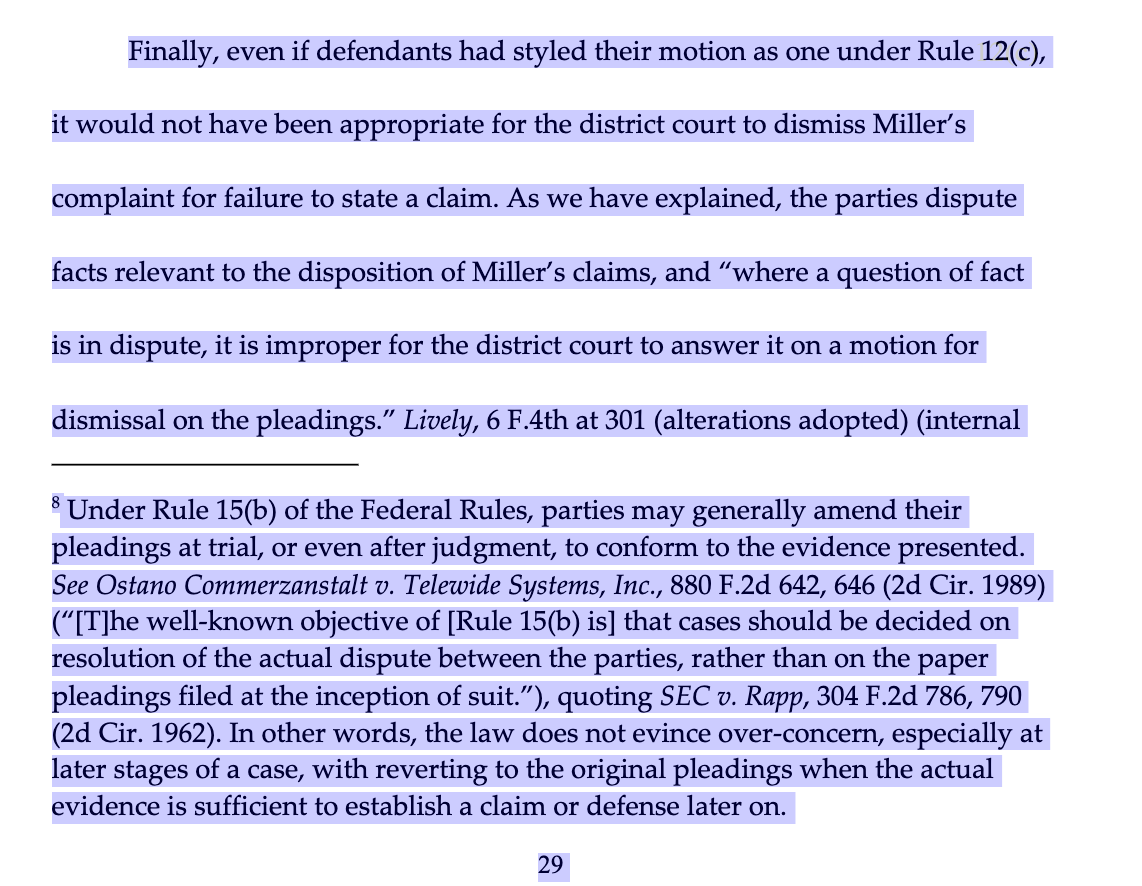
It explained that even if the defendants had formally brought their challenge as a Rule 12(c) motion, dismissal still would not have been appropriate where the factual record is disputed.
The court wrote that:
“where a question of fact is in dispute, it is improper for the district court to answer it on a motion for dismissal on the pleadings.”
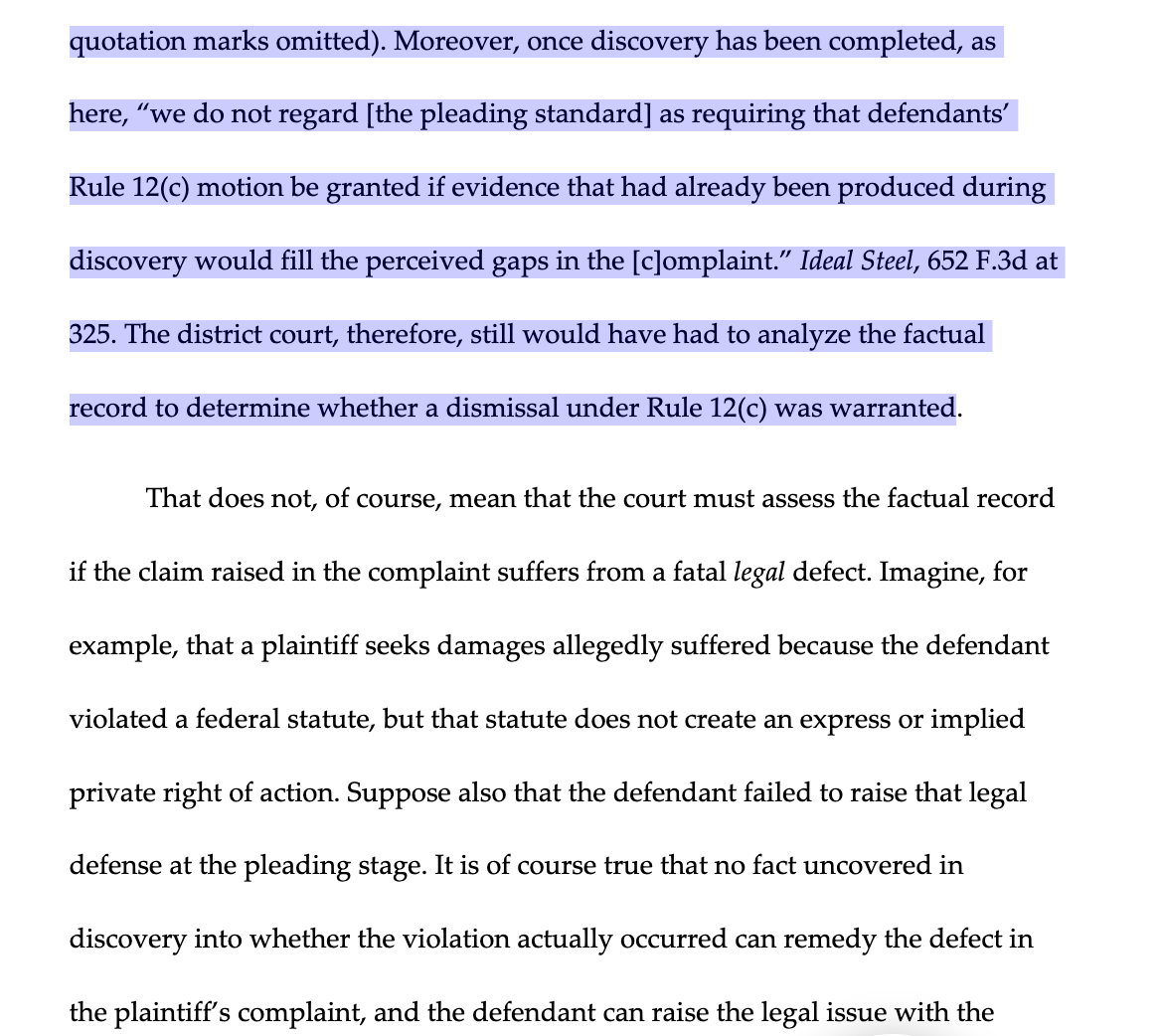
And it went further, explaining that once discovery has occurred:
courts do not treat the pleading standard as requiring dismissal if “evidence that had already been produced during discovery would fill the perceived gaps in the complaint.”
In other words, even if a complaint was thin on paper, evidence developed in discovery can cure those deficiencies, and courts cannot ignore that record when evaluating the claims…
That’s the Second Circuit saying courts evaluate claims based on the evidence that exists now, not just the complaint as it was written at the beginning.
“But What About the Dissent?”
Yes, there’s a dissent. Circuit Judge Sullivan wrote it, and it’s a serious textualist argument. He says Rule 12(c) of the Federal Rules expressly allows a motion for judgment on the pleadings at any time after the pleadings are closed, and that the majority is rewriting the rules based on abstract efficiency concerns. He cites cases where post-discovery 12(c) motions were granted and affirmed. He cites the Supreme Court.
It’s a real argument. He’s not wrong about what Rule 12(c) says on its face.
But he lost. It’s the dissent.
The majority controls. And the majority said (directly, explicitly, in language that could not be clearer) that reverting to the pleading standard after discovery while ignoring the evidentiary record can be procedural error. That’s now binding Second Circuit precedent.
Why This (Might) Kill Baldoni’s MJOP
The situation in Lively v. Wayfarer is what the majority opinion describes. Not analogous. Not similar. It is the thing itself.
Baldoni’s team filed a motion for judgment on the pleadings. They did it after months of discovery. They did it less than two months before filing a summary judgment motion supported by a massive evidentiary record. They asked Judge Liman to evaluate Lively’s claims based only on the complaint, ignoring the evidence to which plaintiff points and reverting to the pleading stage. That is the exact conduct the Second Circuit held was procedural error.
Let me preempt the counterarguments you’ll see online:
“Miller is about a converted motion, not a standalone 12(c) motion.”
Wrong. The majority’s reasoning is not about how the motion was labeled. It’s about the fundamental problem of applying the pleading standard after discovery. The majority said the pleading standard “becomes inapposite” once discovery has occurred. It said its reasoning applies to any “claim or defense,” not just standing. It said courts “cannot ignore the actual evidence and dismiss a case that must be tried.” None of that reasoning turns on how the motion was captioned.
“Lugo was about standing, so Miller only applies to standing.”
The majority explicitly rejected this. “Nothing in Lugo suggests that our reasoning was specific to cases involving standing.” The court held that its reasoning applies a fortiori — meaning even more strongly — to challenges on the merits.
“Rule 12(c) says you can file these motions anytime.”
That’s Sullivan’s dissent. It’s the losing side. The majority acknowledged the text of the Rules and held that the procedural error analysis overrides the timing question. You can disagree with the majority. But Judge Liman can’t. He’s bound by it.
“The defendants in Miller didn’t file a separate 12(c) motion.”
That makes the Lively MJOP worse, not better. In Miller, the pleading challenge was embedded inside a summary judgment motion. Here, the defendants filed a standalone Rule 12(c) motion after discovery (but for their own discovery deficiencies) while pursuing summary judgment just weeks later. If anything, that raises the same concern the Second Circuit identified: reverting to the pleading stage while a full evidentiary record already exists.
The Letter
Michael Gottlieb (one of Lively’s lawyer’s at Willkie Farr) filed a one-page letter today (Doc. 1262) making exactly this point.
He didn’t write a long brief.
He didn’t rehash old arguments.
He pointed to Miller, pointed to Lively’s earlier opposition where she already made this argument, and said: this new decision compels denial of the MJOP.
One page. One case. Done.
SO. What Happens to Those Issues?
The MJOP targeted five specific issues… things like whether California employment law can reach a New Jersey film set, whether the defamation claims are legally sufficient, and whether Lively properly exhausted her administrative remedies.
Those issues don’t disappear. They just get evaluated against the evidence instead of the complaint. And that’s worse for the defendants.
On extraterritoriality (their best argument): instead of just reading the complaint, the court would now consider evidence that Wayfarer is headquartered in California, that the crisis PR campaign was run from California, that the contract has a California choice-of-law provision, and that the defendants themselves filed California-law claims. That last part creates a potential estoppel problem. Hard to invoke California law when it helps you and then argue it doesn’t apply when it doesn’t.
On the defamation defenses: instead of just reading the complaint, the court now sees the actual texts about the “social combat plan,” TAG’s scope of work, and the gap between what Bryan Freedman publicly said (”we did nothing proactive”) and what the record shows actually happened.
On adverse employment action: the complaint might have been thin on this point. The evidence is not.
The Bottom Line?
The MJOP was a tactical play. Baldoni’s team wanted the court to evaluate Lively’s claims on a standard that would let the judge ignore all the bad evidence.
Three days ago, the Second Circuit ruled (in binding precedent) that reverting to the pleading standard after discovery can be procedural error. The pleading standard “becomes inapposite” once the parties have incurred the expense of discovery. Courts cannot ignore the evidence and revert to the pleading stage. And as the court put it: while a complaint’s allegations may be frozen in time, a plaintiff’s claims are not.
Gottlieb’s letter is the kind of filing lawyers love. A new authority that does your work for you, dropped in your lap at exactly the right moment.
The MJOP might be dead.
Lively v. Wayfarer Studios LLC, et al., No. 24-cv-10049 (S.D.N.Y.). Supplemental authority letter filed March 12, 2026, Doc. 1262.
Miller v. Lamanna, No. 24-2314, 2026 WL 643744 (2d Cir. Mar. 9, 2026). Full opinion (PDF).
Thanks for always keeping me updated, wherever I am! ☺️
Beautifully executed explanation, as usual. Thank you for being a legal voice of factual reasoning.